Pronunciation

Ko e ngaahi puʻaki lea faka-Tongaʼ

THE TONGAN ALPHABET (Lau Ā faka-Tongaʼ)

Press play to listen to the sounds.

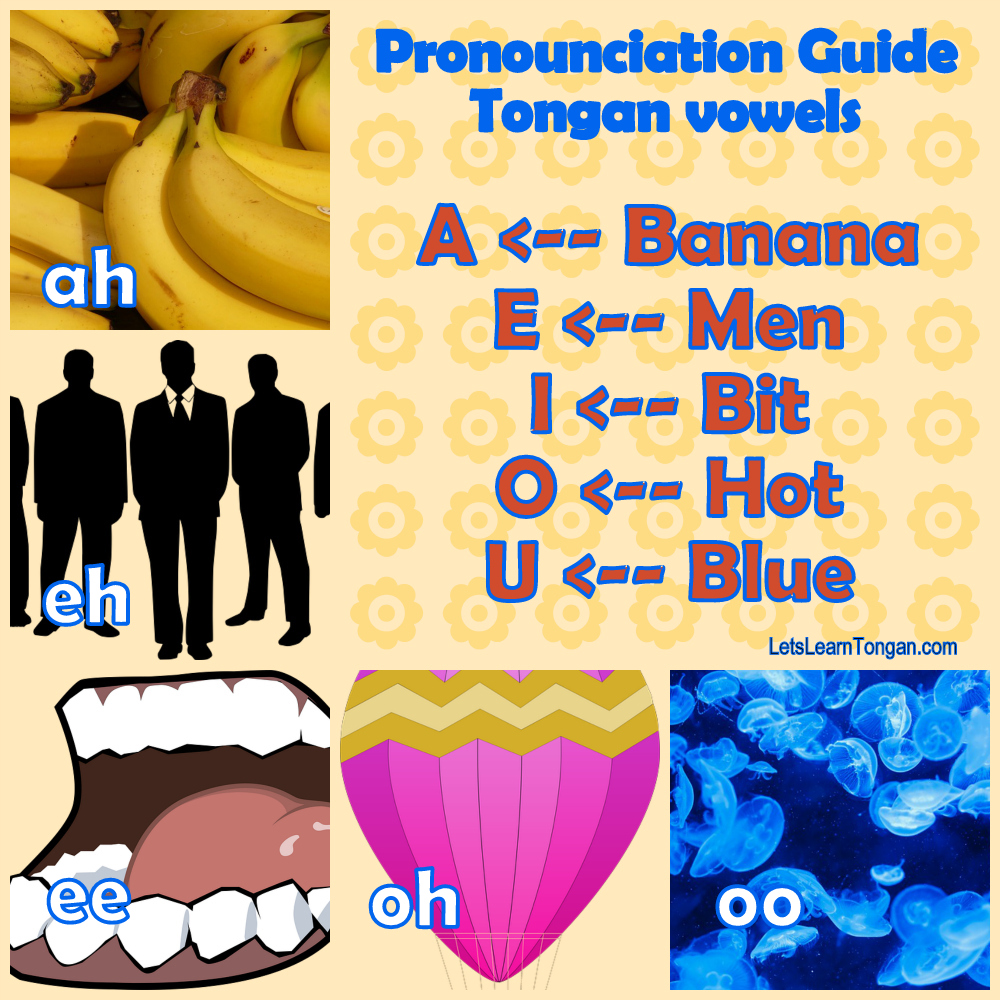
VOWELS (Ngaahi vaueli)

A vowel can be long or short.
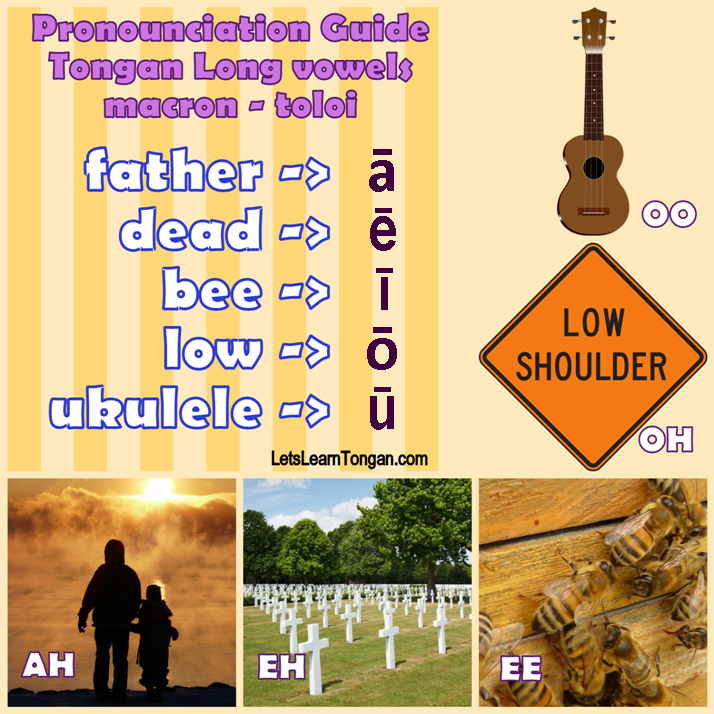
How to pronounce the Tongan vowelsTongan Long vowels Macron Toloi

DIACRITICAL MARKS

There are special markings placed upon the vowels that changes the pronunciation and hence the meaning of the word.

  • TOLOI (macron) – is a line on top of the vowels and it changes the vowels sound to a longer vowel sound (see the picture above)

Play listen and compare vowels sounds with and without a toloi
Kakā, Kākā, Kaka (parrot or barren soil, cunning or a cheat, to climb or a part of a coconut frond)

  • FAKAUʻA (glottal stop) – a backwards apostrophe added before the vowels which changes the vowel sound to a shorter sharper sound.

Play, listen and compare the difference
ʻUma, ʻOfa, ʻAnga (to kiss, to love, shark)


Uma, Ofa, Anga (shoulder, a fathom, ways)

  • STRESS MARK: FAKAMAMAFA PAU (definitive accent) – added at the end of a word, changes the vowel sound to an exaggerated sound at the end of a word similar to the French word resumé.

Play and listen for the difference
Ko e tama, ko e tamaʼ (A child, THE child)

  • STRESS MARK: FAKAMAMAFA HE LEA FIEPIPIKIʼ (Enclitic stress mark)ʻNIʼ is an adverb of time & place meaning here or this. It is also a common enclitic word which wants to join (lea fiepipiki) with many words like ʻahoʼ (day). When ʻniʼ joins together the stress is on the final vowel of the word ie ʻahOʼ to make one word ʻahOʼni (today). It is similar to the English word ʻcan notʼ changing to one word one syllable ʻcanʼtʼ.

CONSONANTS

  • The Tongan language doesn’t have consonant clusters (consonants that appear together in a syllable without a vowel between them).
  • Consonants are pronounced/spelt with an a at the end.
  • Consonants are always followed by a vowel
  • Consonants can only be pronounced in 1 of 5 ways: (example letter f)

Tongan letter F

15 responses to “Pronunciation”

  1. Norma Avatar
    Norma

    This has helped alot to actually be able to no what the words are pronounced as wen u say the word makes it eaiser to learn hiw to soeak tongan thankyou

    1. Hema Fifita Avatar

      mālō ʻaupito thank you for taking the time to comment, I am very glad you find this useful. Mālō Hema 🙂

  2. Becky Avatar
    Becky

    I’m thrilled to have found your website!! My husband is Tongan and I really would love to learn the language better. What a great resource!

    1. Hema Fifita Avatar

      Mālō ‘aupito Becky for your kind words. Happy learning!

  3. rjs42 Avatar

    Hi can you explain that last section there (‘STRESS MARK: FAKAMAMAFA HE LEA FIEPIPIKIʼ ) and how it differs from the other stress mark, I don’t really understand what you are saying there. mālō

    1. Hema Fifita Avatar

      eg. ‘ahoʼ – the day (‘ah-hoh) the stress on the last vowel o
      ‘ahoʼni – today (‘ah-hoh-nee) the stress is on the o as above with the enclitic joining the ‘ni’ to make it one word. English example 2 separate words can & not becoming can’t.

  4. feangai Avatar
    feangai

    malo aupito

    1. yamilet Avatar
      yamilet

      hello i have a bf that’s from tongan and i really want to know how you pronounce his name in tongan, his name is samiuela. thankyou id really appreciate it

      1. Hema Fifita Avatar

        Sah-mee-oo-eh-la pronounce all the vowels

  5. Hank Avatar
    Hank

    Hi Hema,

    I visited Tonga for nearly two weeks earlier this month and found Tongans to be very welcoming, thoroughly Christian and super friendly.

    I would love to learn Tongan so that when I make a.return visit we will be able to communicate with each other. I know that learning Tongan will take effort from my side but it’ll be worth it 🙂

    Thanks for the site!

  6. Evani Taumoepeau Avatar
    Evani Taumoepeau

    Hi! My name is Evani, I’m Tongan/NZ European. I grew up in Tonga but didn’t get the proper opportunity to learn to speak or write in Tongan as I went to an English speaking school and it was seldom if ever spoken at home. I’m now coming to the end of my tertiary studies in Auckland and I want to pick it up and wish to become fluent (written and oral). I just wanted to thank you and your team for putting this together as it is helping me so much. I’m also looking into starting classes with the Pacific Education Center hopefully in Term 2. Thank you again!

    1. Hema Fifita Avatar

      Mālō Evani thankyou for your encouraging words youʻre on a wonderful journey donʻt give up.

  7. Breckon Avatar
    Breckon

    So this was very helpful, I an trying to read a tongan book to improve my reading and speaking out loud. You went out over the words with the ā but how do you say words that have ī , ó, é, or words like he’ene

    1. Hema Fifita Avatar

      The volews with the macron (toloi) is a long vowel sound ā as in father ī as in s(ee). The difference with the vowels with the glottal stop (fakauʻa) is a short sharp sound similar to saying year and ear (fakauʻa) sound.

  8. Mele Avatar
    Mele

    Malo, how do you say ‘go away’

Leave a reply to yamilet Cancel reply