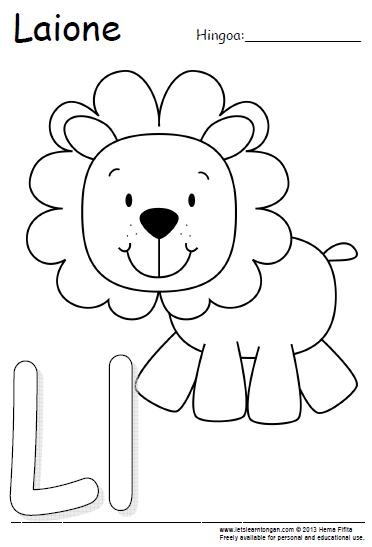
This weekʼs letter activity is the LETTER S pronounced (sah).
Suitable for pre-schoolers primary/ elementary aged, these two pages will definitely keep them occupied for a little while.
Click here to download the Letter S Giraffe Activity
Would be fun to see your completed works. Send it to me or post up on our facebook page. If you like this activity please feel free to share on your network of friends and family.
This is an interview of Lady Fielakepa on the importance of speaking in Tongan. Her story would resonate with many Tongan families as it does with me.
She points to the old belief of her parents that education was important and in order to achieve it one had to be proficient in the English language. Which is great but the downfall of that was the demise of her Tongan language skills. She realised her own shortcomings and has since then strived to improve her own language skills and pushed her own kids and grandchildren to learn Tongan first.
The new belief is to teaching kids at an early age Tongan first. I am definitely encouraged knowing that Lady Fielakepa who is quite knowledgeable in Tongan culture is still a student using the dictionary and continually learning from others about the Tongan language.
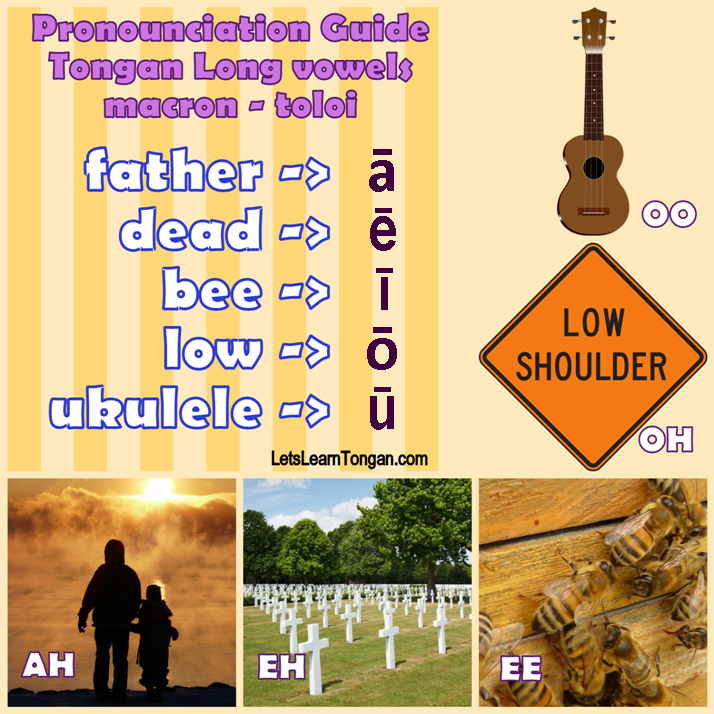
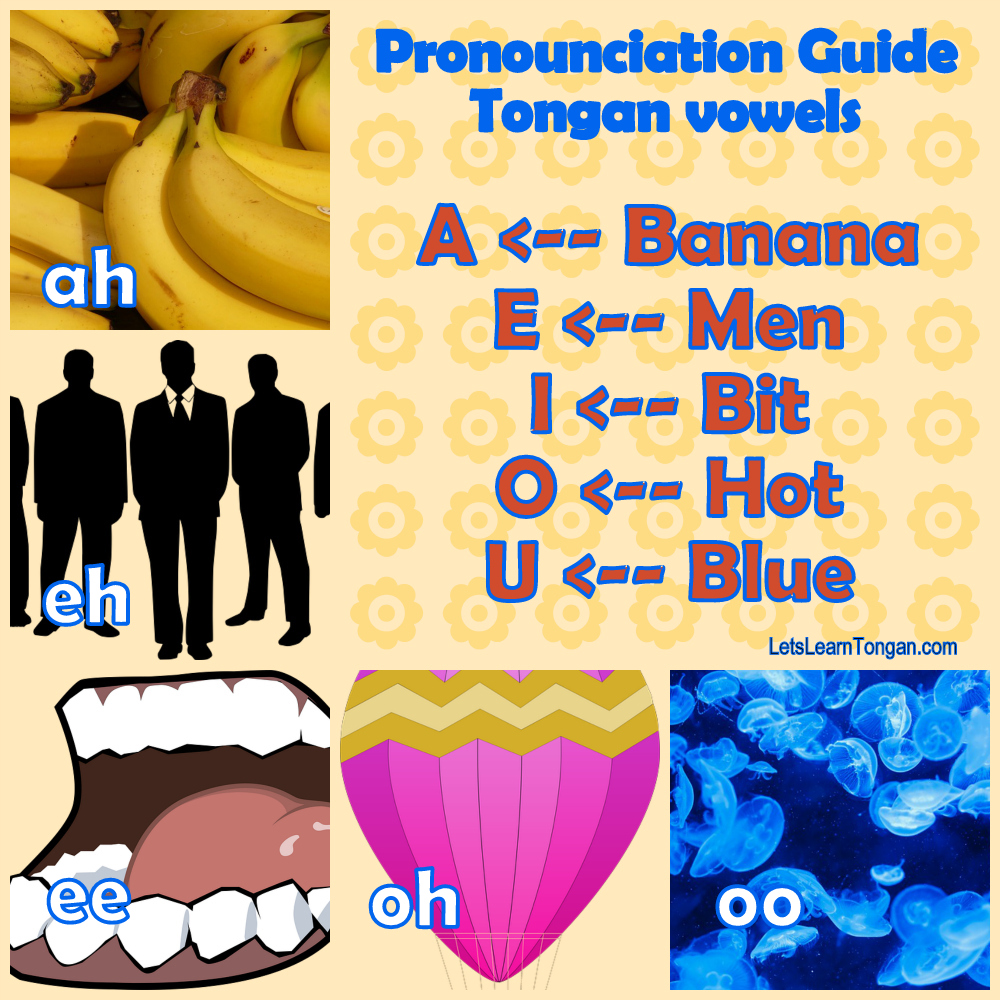
Learn to pronounce the Tongan vowels correctly and you are half way there. All consonants end with a vowel. All Tongan words end with a vowel. There is only one way to pronounce a vowel so the rest should be straight forward. Right! Hope this visual and key words help you to improve your pronounciation.
SUIT: Preschool age. Here is another activity to keep your kids busy. My 2 pre-school boys are enjoying scribbling and colouring in pages at the moment. Mixed in with Ben 10 and Batman colouring in pages, I make sure to add in a Tongan Letter Activity.
When they are done it’s the fun bit for me, Newstime! Ongoongo! Let them tell you all about their picture in Tongan.
Tongan Childrens Song – ‘a e fanga kumā The Tongan version of Three blind mice
Time for a Song! – Three blind mice in Tongan. This is a very popular song for Tongan kids and it is sung to the same tune.
It has nothing to do with the farmers wife who cut of their tails with a carving knife. This song is about the mice and a priest. See all those mice! Where are they running to? They are running after the Priest to eat his bread until each and every crumb is finished.
There is a rule in my house. Lea faka-Tonga! For the most part my kids and I do speak in Tongan. But like most kids nowadays if they are not encouraged to speak the language they will not. My 7yo daughter was speaking Tongan regularly before primary (elementary) school but now has to be prompted. Hence Uncle Sam’s message. A friendly reminder to my kids and myself. ‘Oku ou fiema’u ko e ke ke lea faka-Tonga! I want YOU to speak in Tongan!
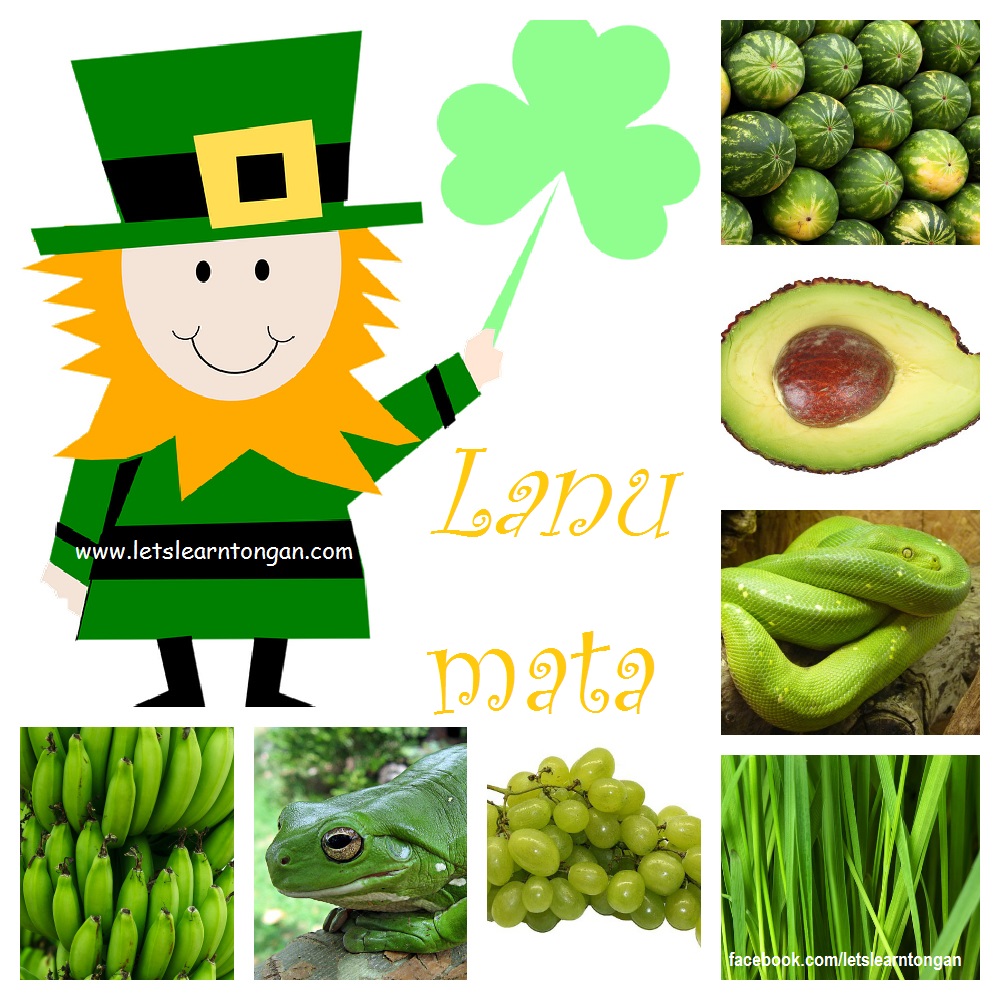
St Patrickʼs day brings todayʼ theme: Colour Green, what can you see around you with the colour green. Ko e tau lēsoni ki he ʻahoʻni fekauʻaki mo e lanumatá. Ngaahi meʻa kehehe ʻoku lanumatá.
Celebrating everything Green.
Practice questions and replies: Ngaahi fehuʻi mo e tali
ʻOku lanu hā ʻa e meleni? What colour is the melon? ʻOku lanu mata ʻa e meleni! The melon is green.
ʻOku lanu hā ʻa e poto? What colour is the frog? ʻOku lanu mata ʻa e poto! The frog is green.
ʻOku lanu hā ʻa e ngata? What colour is the snake?ʻOku lanu mata ʻa e ngata! The snake is green.
ʻOku lanu hā ʻa e musie? What colour is the grass? ʻOku lanu mata ʻa e musie! The grass is green!
Fē ʻa e siaine mata? Where are the green bananas? (point to the picture above and say ko ē – there it is!)
GAME: Are you ready to go treasure hunting. Use the Tongan alphabet, numbers and colours to find the treasure.
SUITABLE: Preschoolers, primary (elementary) kids. Beginners for Adults.
Game: treasure hunt for Tongan items
This is a fun game to play! Get out all your little nick nack toys, and get ready for some fun. This game can be simplified for preschoolers who are learning their colours and numbers. But it can also be made more challenging for older kids by combining colours, numbers, letters and timing them.
I saw this on one of the many kids activity blogs out there and then tried it using our Tongan language. This is by far the best game, according to my 7 year old. She rated it four stars out of five.
Tips for playing this game:
For younger kids keep it simple. Use the option of 1-5 items max, for older kids you can go up to 10 items.
Let your child direct the play. My girl could not find an item starting with ʻlʼ so she came up with the idea to draw the item being a ʻlaioneʼ lion.
Be flexible.The word for many foreign things in Tongan start with meʻa (thing) like meʻa vaʻinga (toy) and meʻa faitā (camera).
Stick to easier letters. Depending on your vocabulary skill level there will be some letters that will be challenging like ʻeʼ and ʻngʼ. I could not find an item for letter ʻeʼ so i got a yellow (engeenga) item.
Have fun!
FOR BEGINNERS! Grab a bowl and collect an item each representing the Alphabet. Then use these items to play treasure hunt. Below are some items that you may have at home in the form of toys, fruits & vegetables and household items.
A – ʻĀpele, ʻAngelo, ʻAnga; Apple, Angel or Shark.
E – ʻElefānite, ʻĒpelikote, ʻĒpani; Elephant, Apricot, Apron
F – Fonu, filo, feke: Turtle, thread, Octapus
H – Hoosi, Hamala, Hele: Horse, Hammar, Knife
I – Ipu, Inu, Ika: Cup, Drink, Fish
K – Kā, Kūli, Kaloti: Car, Dog, Carrot
L – Lemani, Lolo, Laione: Lemon, Oil, Lion
M – Manupuna, Moli: Bird, Orange
N – Neesi, Nima: Nurse, Hand (of a doll)
NG – Ngeli, Ngata: Monkey, Snake
O – ʻOfa, ʻOtua, ʻOfefine: Love, God, Daughter (of a man)
P – Peleti, Pōlisi, Pūsi, Peni: Plate, Police, Cat, Pen
S – Sea, Sipaita, Sōtia: Chair, Spider, Soldier
T – Tamapua, Temata, Tohi, Toketā: Doll, Tomato, Book, Doctor
U – Ulu, Uasi, Uaine: Hair (from doll), watch, Wine
V – Vesa, Vaʻe, Vai, Vakapuna: Bracelet, Leg (from doll), water, plane.
I would love to hear how you guys went with playing this game. Rate it, give me some feedback, did you or your kids enjoy it as much as mine did?






 Let's learn Tongan