Tongan hymn: Te u hiki ‘a hoku le’o lyrics

Beautiful songs need to be shared. Sing-a-long. There is always a lot more appreciation when you know the words and the meaning behind it. Blessed Sunday to you all.

1. Te u hiki ‘a hoku le‘o – I will raise my voice up high
Ke fai ‘atu ‘a e fakamālō – To give you thanks
Lea pē ‘eku hiva’ – The only words of my song are
Mālō Sīsū ‘a ho’o ‘ofa – thank you Jesus for you love/ kindness
2. ‘Alu ai ‘eku manatu – My memories wonders to
Sīsū he ‘aho’ na’a’ke ui ai au – that day that you called me Jesus
Talu ai ‘eku fakapapau – Since then I have decided for Christ
Ko au eni ‘eiki fai mai ha‘o fekau – Here I am Lord give me your bidding
3. Pehe ange mai ‘e au, ‘oku malava – I wish that it be possible
Ka ‘oku ‘ikai ha lea ia ‘e fe‘unga – but there are no words enough
Ke tala atu Sīsū ‘oku hounga – to tell you Jesus I appreciate
‘A e ‘ofa’ kuo u ‘a‘usia – the love I have come to know

{toe hiva mai mei mu’a – repeat from beginning}

Fuaʻamotu and the white horse

This is the story of how Fuaʻamotu got the nickname, the white horse. Ko e tala eni ʻo e hoosi teaʼ ʻa ia ko e hingoa fakateneteneʼ ʻa Fuaʻamotu.

hoositea

Fuaʻamotu, a town in Tongatapu has the unusual nickname of hoosi tea’ which means the white horse. According to oral stories, this name came about during the time of Tungi vaivai, either the father or grandfather of Queen Saloteʼs husband, Tungī Mailefihi. He had a brother who lived in Fuaʻamotu and who would often ride his white horse to visit Tungī vaivai in Mu’a. On one of these occasions, Tungī vaivai heard the trotting steps of a horse and he asked his minders who was that trotting towards them.

Ko hai ‘ena ‘oku patupatū mai? his people replied “Ko e hoosi teaʼ”
Who is that trotting towards us? his people replied, it is the white horse. That is how Fuaʻamotu came to be known as ʻThe white horseʼ town.

Ko e tala ʻo e hoosi teaʼ

Ko e hingoa fakateneteneʼ ʻa Fuaʻamotu ne faʻu ia he taimiʼ ‘o Tungī vaivai ʻa ia ko e tamaiʼ pe ko e kuiʼ ʻa Tungī Mailefihi. Naʻe nofo ha tangataʻeiki ʻi Fuaʻamotu pea naʻaʼne faʻa ʻaʻahi ange ki Muʻa ʻo vakaiʻi ʻene taʻokete ko Tungī vaivaiʼ. ʻI he ʻaho e taha ne fanongo ʻa Tungī vaivai ki he patupatū ʻo pehe ʻange ki heʻene kau tauhi “Ko hai ʻena ʻoku patupatū mai?” Ne tali e kau Muʻa “Ko e hoosi teaʼ”. Aʻu ki he ʻahoʼni kuo ʻiloa hingoa fakatenetene ʻa Fuaʻamotu ko e hoosi teaʼ.

(Anyone who wants to correct my Tongan composition please feel free to do so.)

Tongan slang: Tamani

Tamani
Mani ē faka’ilifia! man that’s scary!

First of our Tongan slang series: Tamani comes from the word Tama = child or boy and Tama’ni meaning this boy. In slang however it is used as an interjection that means oh boy, man! wow, gee. An interjection is an abrupt remark or a side interruption. Or an exclamation esp. as a part of speech, e.g., ah! or dear me!.

I’ve always used the shorter version of tamani which is simply mani and I often say mani ē followed by a whole lot of laughter!

  • Tamani, faka’ofo’ofa ‘aupito ‘a e kofu ‘o Sinitalela. Man! Cinderella’s dress is beautiful.  
  • Mani ē! sio ‘atu ki he fefine’ mo ‘ene vala. Oh wow look at the lady and her clothes.  
  • Mani ē te u lua! Oh boy! i’m going to vomit
  • Mani ē sio ‘atu ka Mele. Gee! look at Mary.

Pronouncing the Tongan vowel A

Pronuncing the Tongan vowel A

Do you know someone who does not pronounce their vowels correctly? Or perhaps it is yourself. There are no more excuses with this visual 🙂 Share it with your friends and family and lets learn Tongan 🙂

The Tongan vowel A for beginners! All you need to know about the vowel A.

  •   IT IS ALWAYS PRONOUNCED AS (AH)!
  • There are marks (diacritical marks) added to the vowels which gives it a special pronunciation.
  1. The toloi (macron) gives it a long vowel (ā) AH sound.
  2. The fakaʻua (glottal stop) gives it a short sharp (ʻa) AH sound.
  3. The fakamamafa pau (definitive accent) gives it an exaggerated (á) AH sound at the end of a word. Think of resume and resumé.

COMPARE with the more complex English vowel a:

  • THERE ARE SEVERAL WAYS TO PRONOUNCE THE A VOWEL
  1. MAN has an (ae) sound
  2. MARS has an (aer) sound
  3. MAKE has an (ei) sound
  4. MA has an (ah) sound

Learning from Tongan hymns: ʻEiki te u ʻi fē?

Hymns are a great way to learn Tongan language. With not much resources around they are a great way to start.

Lyrics

ʻEiki te u ʻi fē, kapau ʻe ʻikai te ke kau mo au
ʻI ho haʻofinima naʻa ne pukepuke au
Ne u hē he teleʻa ʻo e mate ʻEiki ē
Ka kuo ke haʻu ʻo fakahaʻofi au

Where will I be if you are not with me, Lord
He held me so in the palm of his hands
Oh Lord! I was lost in the valley of the death
But you have come to save me!

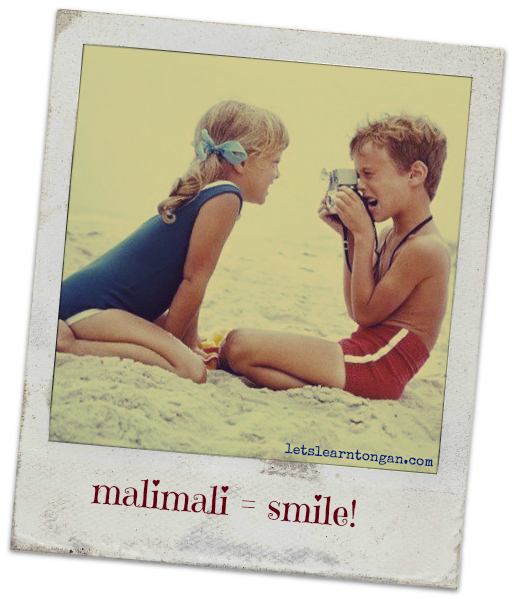
Malimali means Smile!


malimali

In anyoneʼs language kids know how to smile and give them a toy camera and they start acting like professional photographers and happily snap away. So this is a great way to teach Tongan to your kids. Not only are they having fun but they are also learning simple phrases.

Here are some useful vocabulary when you’re playing imaginary paparazzi and superstar or for real life photo shoots.

  1. For Beginners: You could take photos until they get familiar with the phrases.
  2. For Intermediate: They could take photos of you and give you directions

Ko e ngaahi kupu’i lea ma’ae toko-taha fai-ta’ (Phrases for the photographer)

  • Malimali! – Smile!
  • taha ua tolu malimali – 1 2 3 smile!
  • Hanga mai! – Turn this way!
  • Hanga ki hē! – Turn that way!
  • Unu atu! – Move away!
  • Unu mai! – Move closer!
  • Tu’u ma’u! – Stand still!
  • Tangutu ma’u – Sit still!
  • Sio mai! – Look this way!
  • Sio ki ‘olunga – Look up!
  • Sio ki lalo – Look down!
  • Ko ia – that’s it!
  • Faka’ofo’ofa – beautiful
  • Talavou  – handsome
  • Ai fakalelei – Do it properly
  • La’i tā – a photo
  • tangata fai-tā – photographer (male)
  • fefine fai-tā – photographer (female)

Hope this helps you and if you have other phrases to add let me know

Tu’a ‘ofa atu

Counting to 100 in Tongan

Counting in Tongan

So you want to count in Tongan! The basic level of counting in Tongan is easier then you think. All you have to do is learn the numbers 0-10 then you can count from 1-99. Follow these simple rules.

Counting 1-99 in Tongan

  • numbers 0-9 noa, taha, ua, tolu, fā, nima, ono, fitu, valu, hiva
  • the number for 10 is hongofulu (hoh-ngoh-foo-loo)
  • the number for 100 is teau (teh-ah-oo)
  • every other number is literally the words 0-9 combined: twenty becomes two zero – ua noa
  • three exceptions to the rule 22, 55 and 99 words shortened to uo ua, nime nima, hive hiva

Example: How do you say the number …. in Tongan?

  1. 19 (nineteen) – taha hiva
  2. 44 (fourty four) – fā fā
  3. 99 (ninety nine) – hive hiva
  4. 87 (eighty seven) – valu fitu

Test: Can you saying the following numbers in Tongan

  1. 15 (fifthteen)
  2. 33 (thirtythree)
  3. 50 (fifty)
  4. 11 (eleven)

Cold or warm season begins

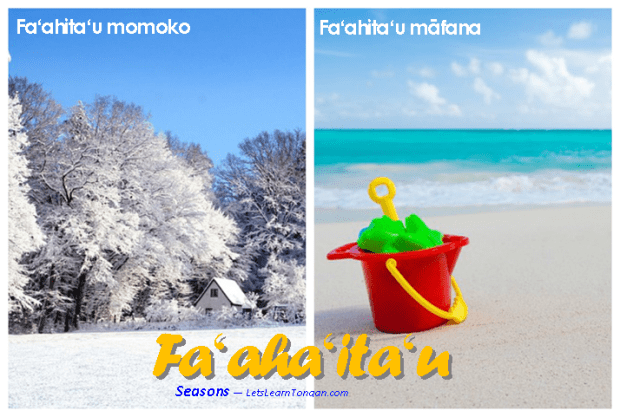
1st day of June and itʻs that time of the year when seasons change. Which season is it for you?

Kuo kamata ʻa e faʻahitaʻu momoko he ʻahoʼni.  Winter time has started today.

Kuo kamata ʻa e faʻahitaʻu māfana he ʻahoʼni. Summer time has started today.

Celebrating all things Green – lanumata

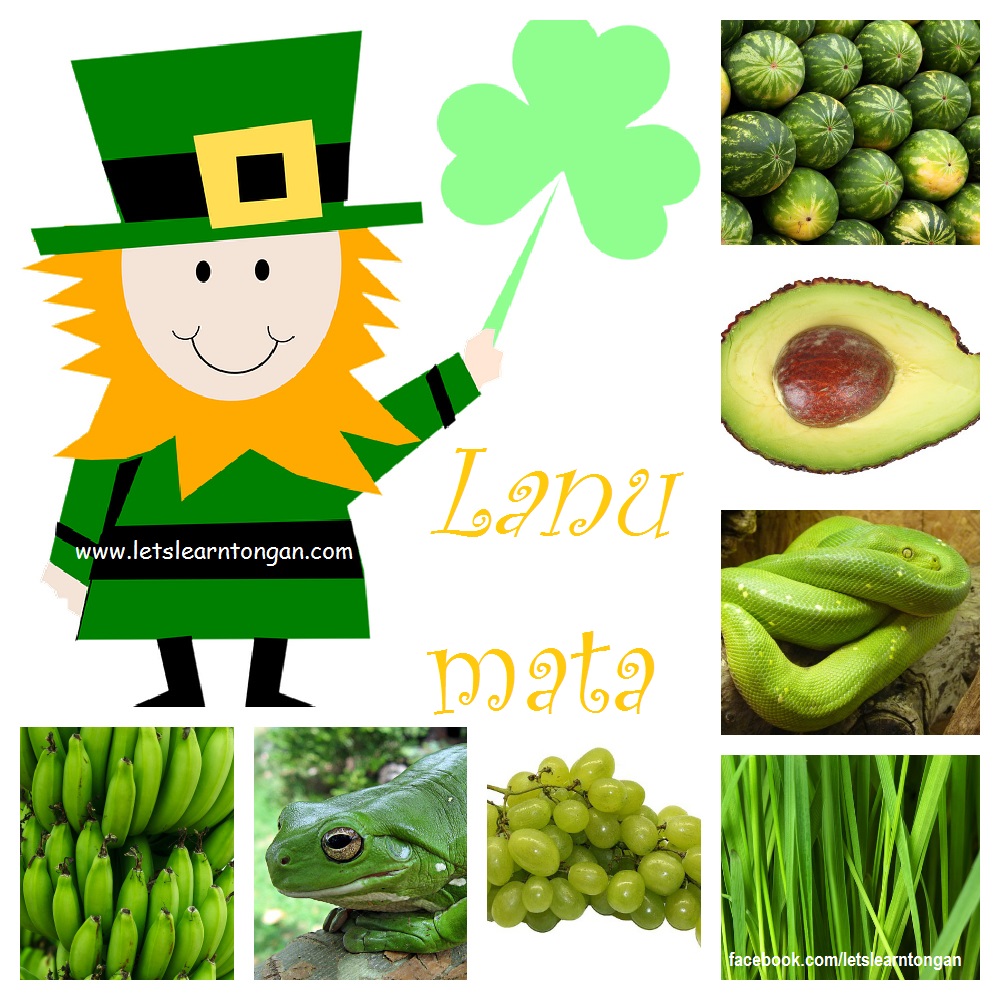
St Patrickʼs day brings todayʼ theme: Colour Green, what can you see around you with the colour green. Ko e tau lēsoni ki he ʻahoʻni fekauʻaki mo e lanumatá. Ngaahi meʻa kehehe ʻoku lanumatá.

Celebrating everything Green.

Practice questions and replies: Ngaahi fehuʻi mo e tali

  1. ʻOku lanu hā ʻa e meleni? What colour is the melon? ʻOku lanu mata ʻa e meleni! The melon is green.
  2. ʻOku lanu hā ʻa e poto? What colour is the frog? ʻOku lanu mata ʻa e poto! The frog is green.
  3. ʻOku lanu hā ʻa e ngata? What colour is the snake?ʻOku lanu mata ʻa e ngata! The snake is green.
  4. ʻOku lanu hā ʻa e musie? What colour is the grass? ʻOku lanu mata ʻa e musie! The grass is green!
  5. Fē ʻa e siaine mata? Where are the green bananas? (point to the picture above and say ko ē – there it is!)
  6. Fē ʻa e kalepi? Where are the grapes? ko ē
  7. Fē ʻa e ʻavoka? Where is the avocado? ko ē

Tongan seasons

Itʼs that time of year when the seasons change. Ko e faʻahitaʻu fē ʻeni? Which season is it?

Is it SPRING? (faʻahitaʻu) season of the blooms (matala) or
Is it FALL/ AUTUMN? (faʻahitaʻu) season of the falling leaves (tō – fall, lau – leaf)

seasons