Tongan hiko

ʻOkuʼ ke poto he hikoʼ ?  Are you skilled at juggling?

  1. ʻIo ʻoku ou poto lelei he hikoʼ – Yes I am quite skilled at juggling
  2. ‘Ikai ke poto au he hiko.  – No I am not good at juggling.
  3. ‘Oku ou vale he hiko – I am not skilled at juggling

It is an ancient art form of juggling and made into a dance performed by girls only. Any girl who grew up in Tonga would have played endless games with the tuitui nuts that they use to juggle with. The words are old and have lost its meaning but it certainly would have reflected the joyness of playing with ones friends and family.

Fuofua peau moʻua peau to he ʻanaua
Faifai peau fepaki, peau toki fehivai
He pai ko ʻulu ko Hateniti hatenata ua nga pe ʻala ma koli
Foʻi koli savaiki ʻa tofolo he pupunu ki lelenga

Ko hoku loto lyrics

Mou hiva mai! Sing-a-long time!

Ko hoku loto
 
Ko hoku loto ke maʻu e Sīsū 
ko ʻeku holi pe kiateia
te u feinga ka ʻikai lava
ko e ʻuhi ko e angahala
ka te u feinga pē ke u maʻu koe

My wish is to find Jesus
I only want him
I will try but will not happen
because of my sins
but I will keep trying to find you

chorus
ka ne ke ʻilo sīsū te u ʻomi mai he ʻahoʼni
pea te u fifili ko hai nai te u ʻofa ai
Kuo pau ke ne maʻu heku meʻa kotoa
ʻo ʻikai ha ʻilo pe moʻoku loto ke ne maʻu mo ia
ko ʻene fiemaʻu ke tokoni
ka naʻa ku mole mei he angahala
ke ne taki ʻa koe mo au
fakafoki ki ʻapi
he ko ʻene fiemaʻu
ke ma nofo mo ia

Describe your ex using a Tongan song title

Describe your ex using a Tongan song title

Taimi fakamuna. Time for a bit of superficial fun and games. This would be an interesting list to compile. There are contemporary songs that are quite funny like Lome Lome and Satana and then there are old ʻHiva hanuʼ (sad songs of lost love) as well as Hiva Kakala which have lots of metaphors.

List of Tongan Song Titles

  • Satana – Satan
  • Lome Lome – Salome Salome
  • Tangi e lotoʻni  – This heart cries
  • Liʻekina (mai siʻi ʻeku ʻofa)  – My dear love has abandoned me
  • ʻE Hina te u tangi – Oh Hina I will cry
  • Pehe ange mai ʻoku kei pongipongi – Come around for it is still morning (metaphor) for wishing one was young again.

Tongan greetings from Randwick Park

Great to see more classes getting interactive with the Tongan language and posting them online. Practice your pronunciation and follow along with the kids from Randwick Park School from New Zealand. Note the intonation right at the end when they are asking a question fefe hake? ʻAlu ki fē?

Vavai ‘a ‘Amelika: a failing of America

I want you to speak in Tongan
I want you to speak in Tongan!

I’m currently travelling in America and the general comments I have been getting from the old folks have been the same everywhere I go.

  • They are happy to hear my children understand and speak in Tongan
  • They are happy to hear a mother speak in Tongan to their children
  • Their comments include “Vaivai ‘a ‘Amelika” America fails when it comes to passing on the language.That their own children understand little of the language.

But is it really only America with this problem? I think the problem is everywhere. Parents and grandparents and the community need to make the Tongan language a priority. Loose the language and you lose the culture and ones identity.

Tongan slang: Tamani

Tamani
Mani ē faka’ilifia! man that’s scary!

First of our Tongan slang series: Tamani comes from the word Tama = child or boy and Tama’ni meaning this boy. In slang however it is used as an interjection that means oh boy, man! wow, gee. An interjection is an abrupt remark or a side interruption. Or an exclamation esp. as a part of speech, e.g., ah! or dear me!.

I’ve always used the shorter version of tamani which is simply mani and I often say mani ē followed by a whole lot of laughter!

  • Tamani, faka’ofo’ofa ‘aupito ‘a e kofu ‘o Sinitalela. Man! Cinderella’s dress is beautiful.  
  • Mani ē! sio ‘atu ki he fefine’ mo ‘ene vala. Oh wow look at the lady and her clothes.  
  • Mani ē te u lua! Oh boy! i’m going to vomit
  • Mani ē sio ‘atu ka Mele. Gee! look at Mary.

Tongan Shortfilm: Feilaulau (Sacrifice)

This is a heart warming little short film in Tongan about feilaulau which means sacrifice. Produced by Tuʻitahi productions,this has a wonderful message to it.

Listen and watch,  cover the subtitles and test yourself if you can follow the narrative.

I think most people can relate to one of these characters.

1. Nicky Brick: The older hardworking brother.

2. Fasiʻeki: The younger wayward brother.

3. Nicky Brickʻs daughter: A daughter who recognises the sacrifice her father makes.

Pronouncing the Tongan vowel A

Pronuncing the Tongan vowel A

Do you know someone who does not pronounce their vowels correctly? Or perhaps it is yourself. There are no more excuses with this visual 🙂 Share it with your friends and family and lets learn Tongan 🙂

The Tongan vowel A for beginners! All you need to know about the vowel A.

  •   IT IS ALWAYS PRONOUNCED AS (AH)!
  • There are marks (diacritical marks) added to the vowels which gives it a special pronunciation.
  1. The toloi (macron) gives it a long vowel (ā) AH sound.
  2. The fakaʻua (glottal stop) gives it a short sharp (ʻa) AH sound.
  3. The fakamamafa pau (definitive accent) gives it an exaggerated (á) AH sound at the end of a word. Think of resume and resumé.

COMPARE with the more complex English vowel a:

  • THERE ARE SEVERAL WAYS TO PRONOUNCE THE A VOWEL
  1. MAN has an (ae) sound
  2. MARS has an (aer) sound
  3. MAKE has an (ei) sound
  4. MA has an (ah) sound

Learning from Tongan hymns: ʻEiki te u ʻi fē?

Hymns are a great way to learn Tongan language. With not much resources around they are a great way to start.

Lyrics

ʻEiki te u ʻi fē, kapau ʻe ʻikai te ke kau mo au
ʻI ho haʻofinima naʻa ne pukepuke au
Ne u hē he teleʻa ʻo e mate ʻEiki ē
Ka kuo ke haʻu ʻo fakahaʻofi au

Where will I be if you are not with me, Lord
He held me so in the palm of his hands
Oh Lord! I was lost in the valley of the death
But you have come to save me!

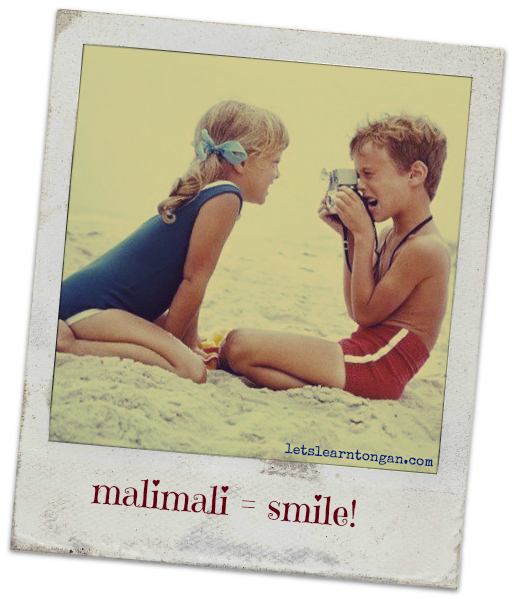
Malimali means Smile!


malimali

In anyoneʼs language kids know how to smile and give them a toy camera and they start acting like professional photographers and happily snap away. So this is a great way to teach Tongan to your kids. Not only are they having fun but they are also learning simple phrases.

Here are some useful vocabulary when you’re playing imaginary paparazzi and superstar or for real life photo shoots.

  1. For Beginners: You could take photos until they get familiar with the phrases.
  2. For Intermediate: They could take photos of you and give you directions

Ko e ngaahi kupu’i lea ma’ae toko-taha fai-ta’ (Phrases for the photographer)

  • Malimali! – Smile!
  • taha ua tolu malimali – 1 2 3 smile!
  • Hanga mai! – Turn this way!
  • Hanga ki hē! – Turn that way!
  • Unu atu! – Move away!
  • Unu mai! – Move closer!
  • Tu’u ma’u! – Stand still!
  • Tangutu ma’u – Sit still!
  • Sio mai! – Look this way!
  • Sio ki ‘olunga – Look up!
  • Sio ki lalo – Look down!
  • Ko ia – that’s it!
  • Faka’ofo’ofa – beautiful
  • Talavou  – handsome
  • Ai fakalelei – Do it properly
  • La’i tā – a photo
  • tangata fai-tā – photographer (male)
  • fefine fai-tā – photographer (female)

Hope this helps you and if you have other phrases to add let me know

Tu’a ‘ofa atu